Full repointing
Every mortar joint on the exposed stack is ground out and repacked. This is common on older Spring Valley chimneys where the original mortar has weathered uniformly across the whole face.
Rebuild and restoration repair for failing chimneys in Spring Valley, NV — repointing, partial rebuilds, and crown work for desert-worn masonry.
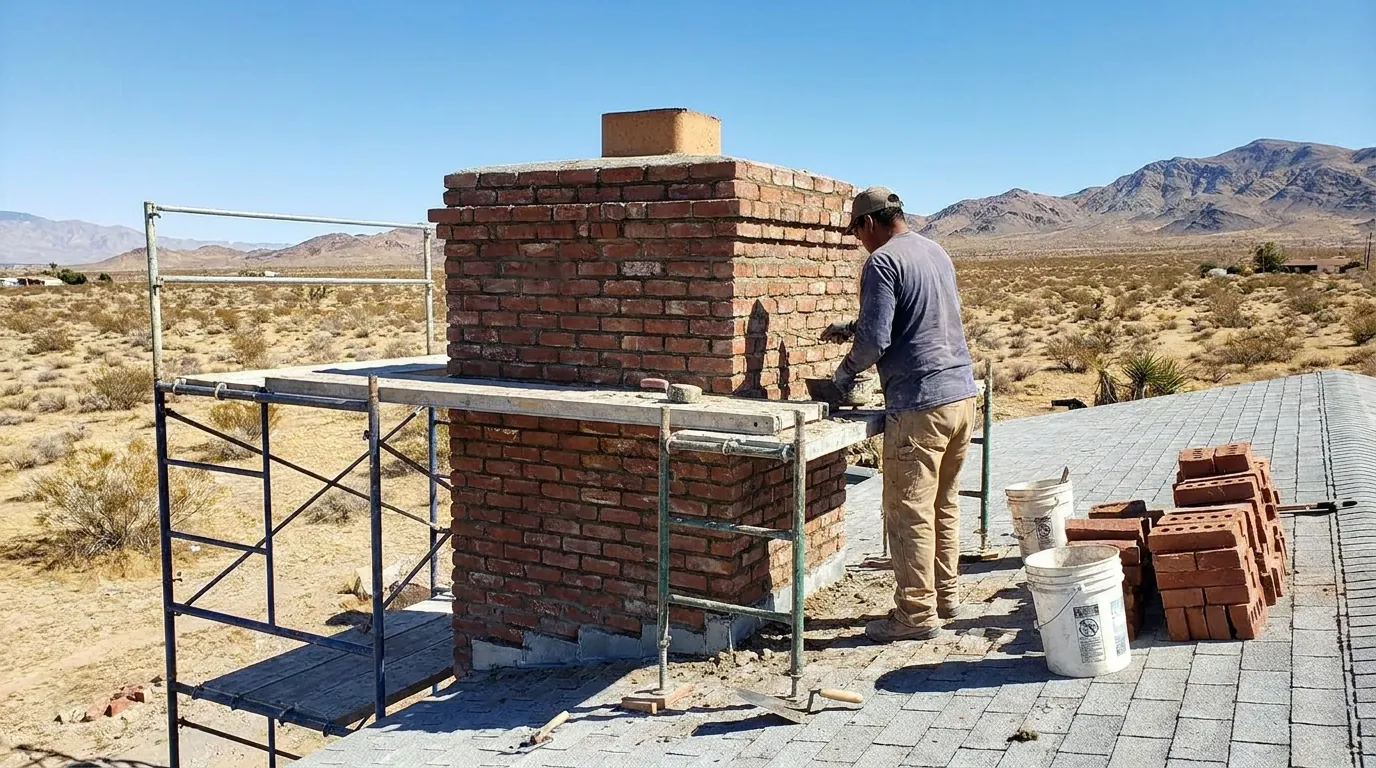
Some chimneys have moved past the point where a single fix will hold. Years of desert sun and dry, alkaline conditions can leave mortar so soft you can scrape it out with a screwdriver, brick faces sheared off across the whole stack, or a crown that has broken into pieces. When damage is that widespread, spot repairs just chase the problem around the structure. This is restoration and rebuild repair work.
The goal is to bring a tired chimney back to a sound, weather-tight condition rather than replacing it entirely. Depending on the damage, that can mean full repointing of every joint, replacing a run of brick, or taking the chimney down to a solid course and rebuilding the upper section. If your chimney only has a localized issue, the lighter-touch chimney masonry repair service is usually the right call instead.
Larger repair jobs usually combine several of these steps.
Every mortar joint on the exposed stack is ground out and repacked. This is common on older Spring Valley chimneys where the original mortar has weathered uniformly across the whole face.
When the upper courses have failed but the base is sound, we remove the damaged brick and rebuild from a solid course up, matching the existing masonry.
A crumbled crown gets removed and recast with a proper slope and overhang so water is thrown clear of the brick below.
After rebuilding, a breathable masonry sealer helps the stack shed the occasional heavy rain while letting trapped vapor escape in the dry heat.
Spring Valley's arid heat is hard on mortar in a way that surprises people. Without regular moisture, decades-old lime and cement mortar can dry, shrink, and lose its grip, so a stack that looks fine from the ground may have joints you can pick apart by hand. That is why full repointing is so common here rather than the isolated joint repairs typical of wetter regions.
New mortar also has to be handled carefully in this climate. Fresh mortar that dries too fast in direct sun never reaches full strength, so we schedule and cure the work to suit the heat. The alkaline soils around the valley matter at the base of the chimney too, where ground moisture and salts can attack the lowest courses. For a full picture of the process, our article on what chimney masonry repair work involves covers each stage in plain language.
If your chimney has widespread crumbling mortar or missing brick, we can inspect it and tell you honestly whether it needs restoration or a lighter repair. Call to schedule a look.
Serving Spring Valley and the surrounding valley.
If mortar is failing across the whole stack, multiple bricks are loose or missing, or the chimney leans, spot repairs usually will not hold. A rebuild or full repointing addresses the underlying condition rather than one symptom at a time.
Yes. When the base is sound but the upper courses have failed, a partial rebuild from a solid course up is often the most cost-effective fix. We match the existing brick and mortar as closely as possible.
Constant sun, wide temperature swings, and lack of moisture cause old mortar to dry out, shrink, and lose its bond. This is why full repointing is more common in Spring Valley than the occasional joint repair seen in wetter areas.
We match brick color, texture, and mortar joint style as closely as the available materials allow. On older chimneys an exact match is not always possible, and we will tell you upfront what to expect.